Saturday, May 28, 2016

A step into winter


Hello Civilization!

You'll be happy to hear I have been successfully nagged into updating this blog, and trying to recap the past 6 months of life at Rothera, so bear with me this might be lengthy.
Waving off the Shack with old flares, as per tradition
So much has changed since my last update, as we have finished a successful summer season and stepped into the much anticipated winter season.

Winter at Rothera, which started on the 26th of March when the R.S.S. Ernest Shackleton left us will last until some time in October when the first planes return.
Now let me introduce you to our team: 21 brave expeditionners with an assortment of jobs to be done.
We have three marine science staff over winter (often referred to as "beakers"), a boatman and dive officer (me!) to help them get the sampling done on a daily basis, a meteorological guru to help us interpret and collect weather data, an electronics engineer to help maintain the complex bits of technology being used here and a communications manager to make sure our lines of contact with the rest of the world remain open. We've got a vehicle mechanic, a generator mechanic, electrician, carpenter and two plumbers to make sure everything we rely on for day-to day living is in good working order and essentially keep us alive. Also here to make sure we stay alive are the four field guides we're lucky to have, allowing us to do winter skill training weeks in the field, our chef - responsible for keeping morale up and bellies full and of course our doctor. In charge of the whole operation is our Winter Base Commander, a former field guide with several winters of experience at Rothera.
Winter 2016 team just starting our season
We've got everywhere from first-time visitors to the most seasoned Antarctic expeditionner ever (who has spent 15 years coming down as a field guide), so there is an absolute wealth of information, and plenty of eager new faces.

On the marine side of things, work has considerably slowed down since the start of winter. We have had more and more challenging weather, the drop in temperatures means the sea froze surprisingly early and we got out to do some sea-ice training and sampling in April.
sea-ice sampling


Thick brash ice diving

But then a heat-wave came through, raising temperatures above our warmest summer level and melting it all away. We've had one stubborn leopard seal just hanging around waiting for the boat to get on the water, and eerily watching the divers from a distance - only to be noticed as we're all climbing back on the boat.
Not only are the environmental and biological factors limiting our diving, but we're also now working with a smaller team, which is often split off into other base responsibilities. Between winter trips, days cooking and nightwatch shifts it is a puzzle in it'self to muster a dive team, and even moreso to have the key participants all available on a good weather day. That being said, we've been doing pretty well at keeping up with the sampling schedules we have in place, and have achieved everything that has been physically possible. Our next step will be to cut some holes in the sea-ice and hopefully get some ice-diving underway.
Setting off on our Winter trip

Open mic night with the band

So instead of diving every day, I've been off exploring the other side of Adelie Island on my winter trip, checking fuel levels in generators on my nightwatch, and singing in the band for fun. I've also been servicing all the diving equipment, updating stock assessments and placing orders- but who wants to hear about that side of stuff?

Home for a week


Winter trips involve each of us getting a week's worth of time in the field, with our own field guide to teach us different skills and techniques used for fieldwork, and which may come in handy should we have to assist in search and rescue operations. We live in a pyramid tent, and travel using wooden sledges that have barely evolved since the day of Scott's expeditions, although nowadays they are towed by snowmobiles rather than dogs.


Snow flying past the tent on a lie-up day
The four in my group travelled through a tricky glacial pass to the Western side of Adelaide Island, being the first to successfully make it to the Myth camp site. After about 5 hours of travel, on skidoos (snowmobiles) linked with our loaded sledges containing everything from food to tents, to emergency tents and whiskey, we finally made it to the famed location.
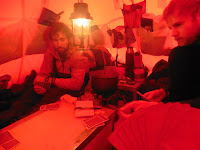
Many card games to keep sane


I spent several days in my tent avoiding the harsh weather, passing the time playing cards and reading, though we sometimes got out climbing and exploring.
After the week away from base (the first time I have gotten to actually be away since arriving in November),

Attempt at climbing Myth
Bright moonlight on the sea

I also got to spend a week on nightwatch, which means I'm working from 10pm until 8 the next morning, ding rounds of the station and making sure everything is running smoothly. In freezing temperatures, it would not take long for essential equipment to be damaged should generators stop working, and it is critical to make sure the proper people are informed as soon as possible.

A by-product of nightwatch: Cointreau Truffles

It also provided one of the few few opportunities to spend some time on one's own, a rare treat when living in such a tight community.


Playing with watercolors on black paper
The other advantage of this solo time is the opportunity to work on our MidWinter's gifts, which we are in the midst of making for a big gift exchange that will take place on the 21st of June when we celebrate the winter solstice and shortest day of the year. (No photos of that since it's still a work in progress, and hopefully a surprise to the recipient!)

Photo credit: Alistair Rose 

This week we had our "Sun down" ceremony, where we marked the beginning of the dark period at Rothera by having our most senior member take down the tattered flag we've been flying this summer. It will be replaced with a new one by our youngest once we get the sun back, some time in mid July.

The rose tinge can always be seen in the clouds


In the meantime we're subjects to stunning never ending sunrise/sunsets, and still have about 5 hours of light, though that will continue to dwindle.
The cloud-scapes are simply stunning


I keep my hopes up for some good diving conditions, and the chance to get out on the ice and cut some holes. But with so many other great distractions and activities I certainly cannot complain - winter life is still an incredible experience.
Sunrise at Myth Camp

Dwindling daylight

Crevasse blues

Layering up for travel

Hopefully blowing bubbles again soon!


Sunday, January 10, 2016

Holiday season

Happy New year!

Hello, I must apologise for this entry being so late, but this place is so wonderfully exciting I've been busy enjoying all the opportunities it offers me rather than sitting and writing about them!

I'm having a bit of a lazy morning though, so here's an update.  
FDO's on our way to look for a lost snowboard


Work has picked up into full swing for me in the last few weeks. We've gone from the four divers that I started working with to about a dozen scientists with different projects and ideas. I officially took the handover from my awesome predecessor Emily on the 31st of December, starting this new year as a team of two Field Diving Officers until she leaves in March. 


Hyperbaric facilities we have on site

The two of us have been working hard on keeping the gear ready for any opportunity to dive, supervising divers and training divers up to operating the hyperbaric chamber we have on site. For me there has been a lot of wrapping my head around the way things operate here, putting my finger on the little things that could use changing and generally getting to know where everything is!  
Icy dives


The team I am currently working with are fantastic, a whole range of backgrounds and experiences, some on their 16th Antarctic diving season, some on their first. Everyone seems to be genuinely excited about the opportunity to be here and get in the water though so for now it seems like we are off to a great start.  


Diving-wise we are limited by many factors so some days it looks like the most beautiful weather and yet we can't get out and make use of it. If there is too much brash ice or sea ice pushed up into the site we want to dive or on the wharf we are restricted in our boating abilities and that coupled with the wind directions might prevent us from diving even when the ice is still a ways off in case we get trapped. 

Perfect example of a Lep
frustratingly spotted before a dive

Diving on the James Clark Ross
We also have to be weary of leopard seals, which are one of the apex predators that live in Antarctic waters along with Orcas. To keep our divers out of danger, we post a lookout “sealwatch” to keep an eye on the site we are diving at for the half hour before the divers get in the water. If there are any leopard seals or Orcas spotted we'll postpone any diving for four hours. This also means we need to be able to see far enough to be confident we'd see any approaching dangers so heavy snow days are usually a challenge.
I will do my best to write a separate entry about the different diving projects and technicalities of our diving operations so you can find out a bit more detail but it might be a while.  
When the conditions are simply perfect

New addiction!
So, when I'm not at work on a boat supervising divers or diving, filling tanks and fixing gear or just avidly watching the weather trends I've been milking the rest of this Antarctic experience as much as possible. One of the best features of living and working in Antarctica is that the people you work with seem to mostly be of the same ilk. I have colleagues who are kite-skiiers and happy to teach (I'm absolutely loving learning kite-skiing!), avid rock-climbers or ice-climbers.
Ice-climbing on a sunny sunday


Skiing is as easy here as waking up, walking over to set up a pair of skis and walking across the runway to our closest ski slope. If there's two of us we can grab a skidoo and take turns pulling each-other up the hill, or you can just walk up the hill, or get some skins on your skis and ski up. If you're feeling a bit more athletic you can go for a 14km trip around a marked flag-line, either on skis or on foot.  


Adelie showing off

Rarely spotted Chinstrap


Another option a bit closer to home is to go for a walk around the point on which Rothera sits. An easy path along the water's edge, picking your way past elephant seals and adelie penguins towards a beach from which you can see the mountain peaks of the Antarctic Peninsula behind a stunning array of icebergs. 


Yes, it's absolutely breathtaking here.  
Antarctic Peninsula behind some icebergs.... the usual
The JCR approaches
I might have to stop here for now as this is starting to drag on a bit and I know you're just excited about seeing the photos. I'll just quickly mention we had the James Clark Ross in port over New Years, resupplying the station in fresh food and fuel and supplies. This put a halt on any other work as everyone pitched in together to get the cargo unloaded as swiftly as possible and put away. We then got to relax and enjoy a fantastic New Year's eve party in the boatshed where a stage had been set up and some extremely talented colleagues performed. Shouldn't come as much of a surprise that I danced and drank my way into the new year.  

Rothera Base
All that being said, I'll get back to the exciting things life has to offer down here, including the Sunday brunch that awaits me and the potential ski trip that will follow it. Hope everyone had a most wonderful holiday season and has 2016 starting out wonderfully.


TERNS!

Monday, December 7, 2015

Rothera Life

Hello all!!!!
I am a bit delayed in letting you know that I have safely made it here to Rothera, but better late than never!
Twin otter in flight


After a long day of flying from Europe to Punta Arenas, we got laid up there for a few days before the weather cleared up enough for us to catch our flight to Rothera. Even then we actually only made it half way on our first attempt, having to turn around and head back to Chile due to a thick fog that was going to beat us to our destination.

ROTHERA!!!!


Needless to say, we were all ecstatic when we finally got to see Adelie Island and Rothera's distinctive green buildings out of the window as we flew over the stunning landscape that is now home.

But I'm not sure stunning quite cuts it as a descriptor.


Once we arrived and were promptly fed (something that happens every two hours around here), we had to sit around for a few training sessions and some orientation around base. After that we were able to wander "around the point" and meet some of our fellow mammalian friends - the elephant seals that very much liter the station (and are slowly encroaching more and more up to the buildings).

Leopard seal napping on an ice-flow
Otherwise we have a few other furry friends around, the Weddell seals, Crabeatears and even the elegant Leopard seal (which every time they are spotted we are on hold for diving operations). And we have spotted a few little groups of Adélie penguins waddling about base as well as the occasional Emperor.


Within our first week on base, most of our days were occupied with different bits of training, including some refreshers on the rope training we did a few months ago.
This time however the practice actually involved jumping off a snowy cliff instead of just lying on the grass pretending. It was also followed by an overnight in tents and some decently windy conditions, where we got to set up camp at the base of our local ski run, and eat old military ration packs.

My saviours!

Field training

After all that training and initial excitement, the most exciting part began for me when I got to finally get in the water for a dive! I had been a bit sniffly for the first few days at work, so was content sitting on the boat and helping with the surface side of diving operations here up until then.
But wow was it worth the wait, even on the "boring" dive near the wharf, I was reminded how great the visibility is underwater here and just how colorful everything really is.
As seen from the boat, 6m above the divers


Last photo by my camera.... :(
Sadly that dive also got the best of my new camera, so I will be doing my best to get that replaced quickly!

Now if you remember, I'm a bit of an avid skiier aswell, and have sadly not really gotten the chance to do much downhill skiing in the past few years.
Being towed up behind a snowmobile is great fun

Back on skis!!! At Vals


At Rothera we have the ability to just grab some skis and head out across the runway to ski down "the ramp", where we take turns towing each-other up the hill behind a snowmobile, or go a little further to Vals for a bit more skiing. And those are just the runs easily accessible on our own! With a bit more training and time I should be able to get out to some other areas in the company of a field guide and get some more skiing in!

Needless to say, this is my sort of heaven on earth. Getting to dive, and ski and have great company while looking out the window at some of the most stunningly rugged mountain landscapes and wild animals is truly exceptional.

I'll be back with some more technical updates in a bit, but for now I hope you enjoy this first set of photos and stories, and are staying happy and warm in this approaching holiday season!

After work drink on a "dingle" day!

Oh, and if you hadn't noticed, I chopped off all my hair on arrival to Rothera. The idea behind this was that men often grow their beards out during their Antarctic stay, and for lack of sufficient facial hair, I figured I would allow my hair to grow out and be a bit of a descriptor for how long I have been down here.